The plan was to take a two-hour guided tour through Machu Picchu, hike the neighboring Huyana Picchu peak and then spend the afternoon further exploring the area and perhaps taking in a little sun, but unfortunately the morning rain literally put a damper on our plan.
None the less, we stayed the course as much as possible. We took the guided tour and walked the entire Machu Picchu site learning about Incan homes, farming, religious ceremonies, and rituals for honoring the dead.


The entire Incan civilization is estimated to have had close to 10 million people at its peak, that's equal to the population of Arizona, Nevada and New Mexico combined. And one of the dynasty's biggest achievements is not only the creation of Machu Picchu, which is arguably the most famous sight in all of South America, but keeping it hidden from the Spanish when they invaded in the 1500s. The Spanish sacked Lima, Cusco, Pisac, Ollantaytambo, and numerous other cities and sites, but because of its location on the top of a ridge tucked between bigger mountain peaks, the Spanish never found Machu Picchu.
There are different theories on what exactly Machu Picchu was used for, but the most popular belief is that it was a gathering site for numerous tribes of Incas to meet, exchange goods, worship, and live. The Incas eventually abandoned the city in the 1500s and it was left to be reclaimed by nature.


Everyone was well equipped for the heavy rain with ponchos, thick jackets, and large umbrellas...

Except us...we learned quickly that our "rain jackets" were more water resistant than water proof, and to add insult to injury, Greg's umbrella was the smallest on the mountain barely covering his head and shoulders.

As for Matt, the tour guide singled him out of the group of 20+ people as being the most soaked and therefore the most in need of his extra poncho...I guess this is what you get when you send two California boys to the Andes.
The entire Incan civilization is estimated to have had close to 10 million people at its peak, that's equal to the population of Arizona, Nevada and New Mexico combined. And one of the dynasty's biggest achievements is not only the creation of Machu Picchu, which is arguably the most famous sight in all of South America, but keeping it hidden from the Spanish when they invaded in the 1500s. The Spanish sacked Lima, Cusco, Pisac, Ollantaytambo, and numerous other cities and sites, but because of its location on the top of a ridge tucked between bigger mountain peaks, the Spanish never found Machu Picchu.
There are different theories on what exactly Machu Picchu was used for, but the most popular belief is that it was a gathering site for numerous tribes of Incas to meet, exchange goods, worship, and live. The Incas eventually abandoned the city in the 1500s and it was left to be reclaimed by nature.

10,000 Incas started work on Machu Picchu in 1450 and it's believed to have taken 70 years to build.

It's believed that one of the reasons the Spanish never found Machu Picchu is because the area is often cloaked in clouds and mist and therefore tough to see.

Machu Picchu is one of the most well-preserved ancient sites in all of South America and amazingly, it looks today very much as it did when it was created.

Machu Picchu is comprised of an upper and lower section of houses, temples, plazas, and terraces. The higher class lived toward the top and tended to have better stonework.
Once the morning guided tour ended we decided the heavy rains were not the right conditions for hiking Huyana Pichu, the "Young Mountain." Instead we took shelter in the picnic area with some fellow travelers who were also hoping to wait out the rain.


Greg enjoying a juice box while waiting out the rain.

Even the locals were in the picnic area taking shelter from the elements.
After a three hour rain delay, the weather cleared a bit so we got back on the "Old Mountain" and finished exploring. Our patience paid off as we were able to see, experience and capture amazing images of the area. It is one of the most beautiful and surreal places we have ever been. Everywhere you looked was an amazing view. Hopefully, the pictures below give you a sense of Machu Picchu's size, architectural intricacies, engineering prowess, and how the whole site is nestled into a massive mountain range.


The clouds began to clear in the afternoon allowing for picturesque views of the entire Machu Picchu ruin.

Greg striking the Colin Kaepernick pose on top of Machu Picchu.

Speaking of football, the expansive grassy areas throughout the ruin would have made for perfect athletic fields.

Cut with stone or bronze tools, the edges of the stones were rubbed smooth until they merged together perfectly.

The Temple of the Three Windows was used for ceremonial rites.

The Temple of the Sun is the only round structure within Machu Picchu and has two tower windows that align to the points where the sun rises on the summer and winter solstices.

The ruin was an intricate maze of walkways, stairways, plazas, rooms, and terraces.

It's still a mystery how the Incas managed to transport the massive stones and granite they chiseled from the mountain cliffs.

The stones in the walls were fitted together flawlessly like pieces of a jigsaw puzzle without mortar.

One of the most exhilarating and scary parts of the ruin was the "Inca Bridge," which is a back entry pathway to Machu Picchu cut into the side of the mountain. The Incan army would take the bridge when returning from battle.

The Inca Bridge path is about 4-feet wide and winds around the side of the cliff face.

Living on the edge. There's no rail or guard on the Inca Bridge; it's just a straight drop.

Greg tested his limits; you can see that the path is not that wide and a bit rocky at some points.

It's about a 2,000 foot drop from the pathway to the valley floor.

Matt trying to feed the llamas, but they wanted nothing to do with him.

Greg on the other hand was a llama whisperer.

A view of Huyana Picchu, the iconic mountain peak that acts as the backdrop to Machu Picchu.
At the end of the day, I'd say we succeeded. It wasn't a homerun since it was rainy in the AM and still a little cloudy in the afternoon, but overall we explored the 15th century ruin from top to bottom, took some amazing pics, and got the full experience we were hoping for.
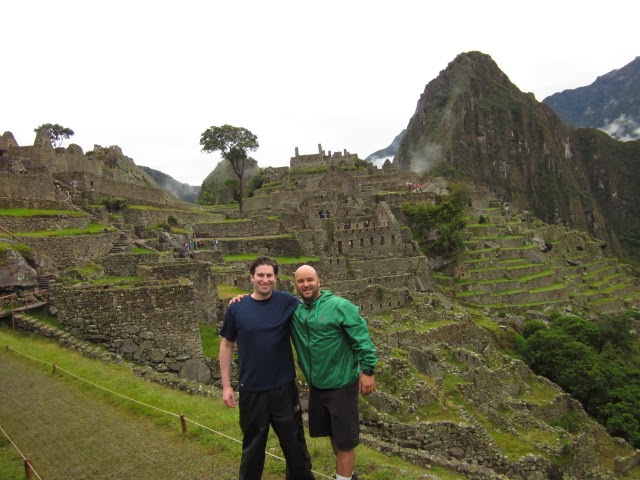
The last picture of the day...almost no clouds...definitely worth the wait.
We descended the mountain by bus around 4pm. We dried off and then took a brief ciesta before grabbing a bite to eat and exploring the small town of Aguas Calientes.
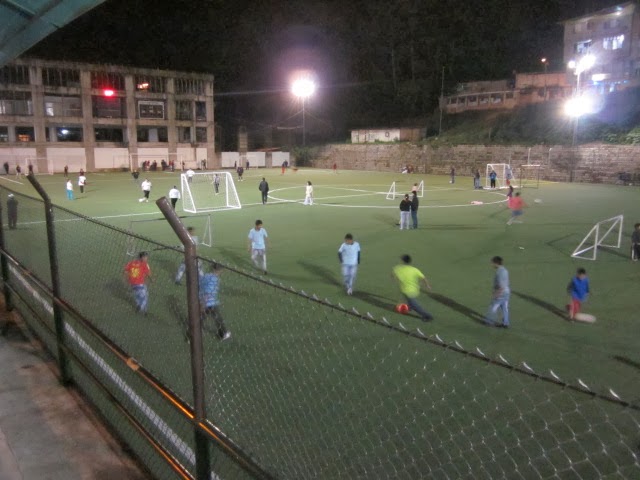
While walking around Aguas Calientes we came upon a local park with recreation soccer games going on.

Dinner consisted of street meat from the local vendors outside the rec league field.

Matt went with the carne...what type of "carne" is still TBD.
Friday we head back to Cusco for a relaxing day in the Incan capital city.